

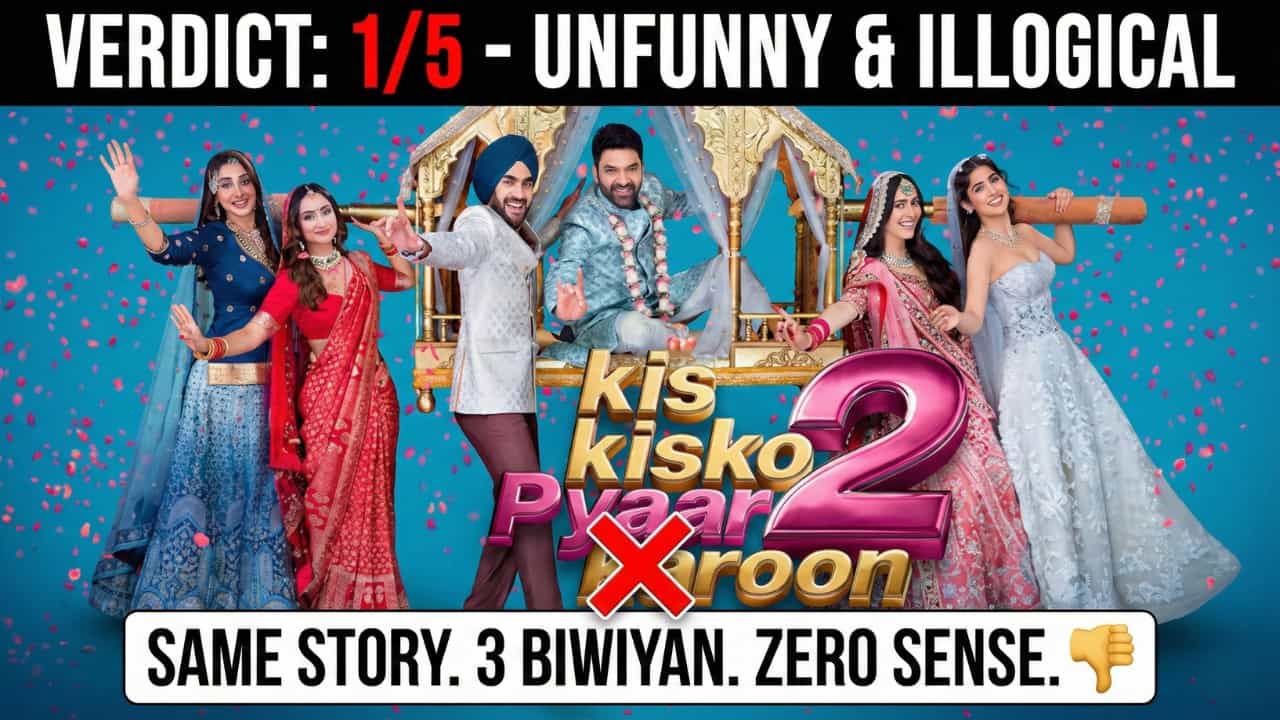
Kis Kisko Pyaar Karoon 2 Review
When “Repeat” Replaces “Refresh”
Ten years is a long time in comedy.
In 2015, Kis Kisko Pyaar Karoon introduced Kapil Sharma to the big screen with a full-blown confusion comedy about one man, three wives, and a pile of lies. A decade later, Kis Kisko Pyaar Karoon 2 arrives… and within minutes it feels less like a sequel and more like someone hit “duplicate file” on the old script, changed a few names, tossed in a couple of new twists, and called it a day.
For a comedian of Kapil Sharma’s stature, that’s the most disappointing part.
A Sequel Stuck in 2015
The film opens with Kapil’s character, a Hindu man, showing up at a baba’s place with his Muslim girlfriend, looking for a solution to get married. On paper, this could have been an opportunity for sharp, modern humour or social commentary.
Instead, the scene lands with a dull thud.
Nothing about the setup feels fresh. It’s not unique, it’s not clever, and it certainly doesn’t announce, “Hey, this sequel has something new to say.” It feels like a generic comedy opening you’ve seen a hundred times before, just with a different religious combo.
From there, the movie quickly slips into a familiar groove:
one man, multiple marriages, endless lies, and rising confusion.
The big “difference”?
In the first film, Kapil’s three wives lived in the same building.
In the second, the three wives are kept separately.
That’s not evolution. That’s a location change.
Comedy or Just Chaos?
Let’s talk about the humour, because that’s the entire selling point of a Kapil Sharma film.
There are a few genuinely funny ideas:
Kapil dragging beggars in as witnesses for marriage registration – that’s a fun, absurd concept and it actually works on screen.
The “qubool hai” stance during the Muslim wedding is amusing, mainly because of Kapil’s awkward body language.
The blood donation camp scene, where his character donates blood three times, is one of the rare sequences that feels properly thought-out and genuinely hilarious.
And in the climax, the big confusion finally kicks in with some decent energy and chaos that actually earns a few laughs.
But these moments are scattered like tiny islands inside a sea of unfunny writing.
For a large chunk of the movie, the jokes feel forced and lazy. You can sense where the punchline is supposed to be, but it just doesn’t land.
And then there are the “what are we even doing?” moments.
The CPR Gag: When Comedy Turns Cheap
One of the most striking examples of bad writing here is the CPR gag.
Kapil’s character “gives CPR” to a girl, which turns into a full lip-lock. Not once. Twice. In the same film.
The first time, it already feels cheap and outdated.
The second time, it just becomes uncomfortable and lazy.
This isn’t clever physical comedy or satire. It’s just using the excuse of CPR to sneak in a lip-lock and call it humour. For a 2025 audience, that’s not just unfunny – it feels tone-deaf.
“Majnu Bhagao Beti Bachao Andolan” – Joke or Just Noise?
Then there’s the bizarre slogan: “Majnu Bhagao Beti Bachao Andolan.”
It sounds like someone grabbed a serious social campaign title, mashed it into a random phrase, and assumed the absurdity alone would make people laugh. But there’s no sharpness, no punch, no actual joke. It’s just noise dressed as comedy.
These kinds of moments drag the film into what you could call “ghatiya writing mode” – where the script stops trying to be smart and just throws anything at the audience hoping something sticks.
The Saniya Disaster: How to Forget Your Own Plot
But the biggest problem of all isn’t even a joke.
It’s the story itself – specifically, the character around whom the entire mess supposedly begins.
The whole chain reaction of multiple marriages starts because of one girl – Saniya.
You’d expect her to be central to the story, right?
Wrong.
As the film moves on, Saniya basically vanishes from the narrative. No emotional arc, no proper tracking of what’s happening to her, no real presence in the middle of the film.
It’s as if the filmmakers simply… forgot about her.
Then, in the end, she suddenly reappears – this time as a Punjaban – and Kapil’s character, now dressed as a Sardar, ends up marrying her too. That makes it marriage number four.
At this point, you’re no longer laughing at the chaos – you’re staring at the screen wondering:
“What is happening… and more importantly, why is this happening?”
To make things worse, her family doesn’t seem to care where she is, what condition she’s in, or what’s going on in her life. There’s zero emotional weight, zero realism, and zero effort to make the situation feel like anything more than a prop for gags.
When your main plot catalyst is treated like a background extra, your story has a serious problem.
Same Ending, Same Arc, Same Everything
Even the ending feels eerily similar to the first film.
Again, we see the same pattern:
confessions, chaos, emotional monologue sprinkled with humour, and a “somehow it all works out” wrap-up. Except this time, it’s stretched with an extra marriage and a lot less charm.
Sequels are supposed to expand the world, deepen the characters, or at least take the concept into a new direction.
Here, the sequel behaves like a weaker, more confused clone of the original.
The Kapil Sharma Question: Where’s the Creativity?
This brings us to the biggest question.
Kapil Sharma is not some random comic trying his luck. He’s one of the most famous comedians in the country, with years of TV dominance, live shows, and now a presence on Netflix.
So how does someone with that kind of experience and instinct end up fronting a film that feels this lazy?
It genuinely feels like an attempt to recreate the first film’s magic without any real effort to update the storytelling, humour, or emotional stakes for today’s audience. As if the thought process was:
“The first one worked. Let’s do the same thing again, add a few new twists and cameos, and people will watch for nostalgia.”
Unfortunately, today’s viewers have seen better, sharper, smarter comedy. You can’t just recycle the same structure and expect them to clap.
Ginni’s Cameo: A Cute Surprise That Can’t Save the Film
One of the few unexpected moments is the appearance of Kapil’s real-life wife, Ginni in the film. It’s a fun, meta surprise and will definitely make some fans smile.
But cameos and surprise entries can only decorate a film. They can’t fix a fundamentally weak script.
Final Verdict: A Tired Sequel That Never Wakes Up
At the end of it all, Kis Kisko Pyaar Karoon 2 feels like a sequel that never asked itself the most basic question:
“What new are we offering?”
Same confused hero.
Same marriage chaos.
Same style of climax.
But with cheaper jokes, weaker logic, and a central character (Saniya) who literally disappears from her own story.
There are a few funny scenes, yes. You’ll probably chuckle at the beggar witnesses, the blood donation chaos, and some last-act confusion. But those moments aren’t enough to justify the runtime or the sequel’s existence.
Rating: ⭐ 1/5
For a random slapstick comedy, this would be forgettable.
For a Kapil Sharma film, 10 years after the original, it’s just plain disappointing.
