

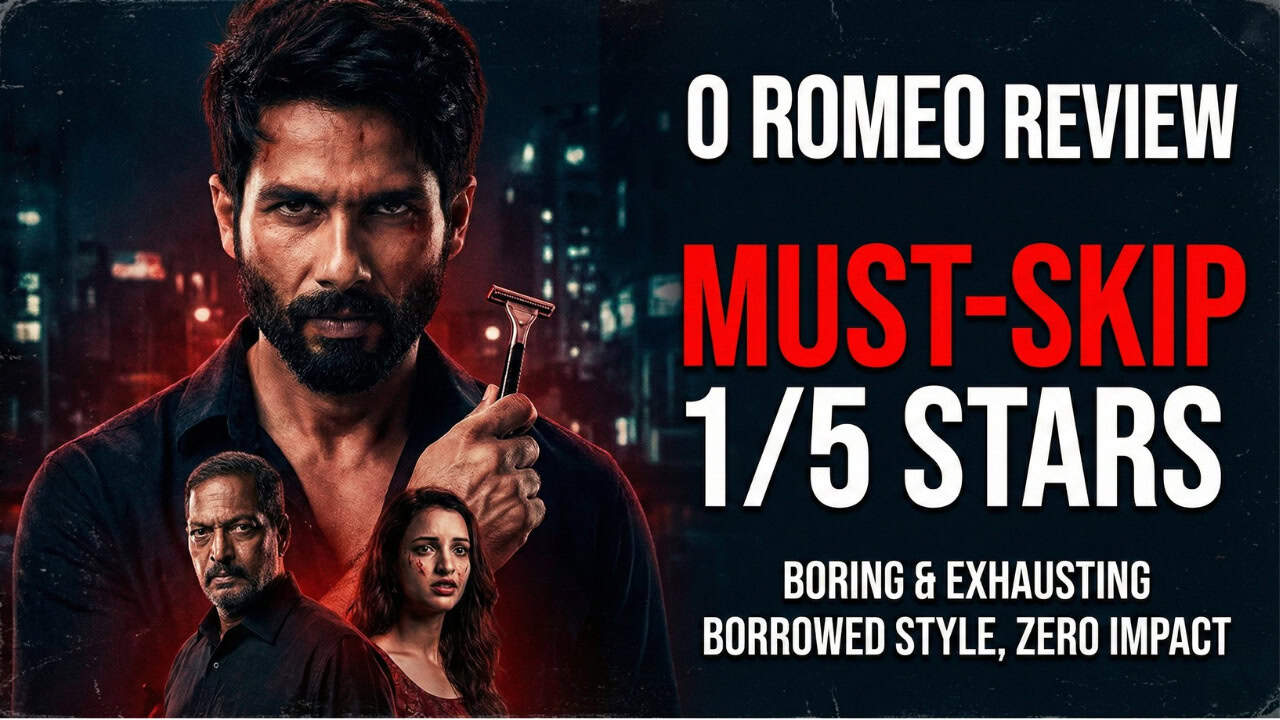
O Romeo Review
O Romeo opens with the kind of swagger that immediately tells you what the film wants to be: Shahid Kapoor walks in carrying an attitude that feels like a mash-up of Kabir Singh’s rage and Ranbir Kapoor’s Animal-style violent bravado. On paper, that mix could have created something dangerously magnetic. On screen, it mostly becomes a reminder of how often Bollywood circles back to the same “hit” template—until you start wondering how long the industry will keep reheating one successful recipe and selling it as something fresh.
And reheated is the right word here, because once the film gets going, there’s so much blood on the screen after a point that you stop reacting to it. It doesn’t shock, it doesn’t thrill—it just sits there, piling up, like the film is hoping quantity will replace impact.
Shahid Kapoor: Intensity Without a New Shade
Shahid brings intensity, no doubt. The problem is that his character carries the same flavor he had in Kabir Singh—that familiar storm of aggression, mood swings, and emotional volatility. Instead of feeling like a new man with a new wound, it starts to feel like a recycled personality dropped into a different costume.
Even the character name doesn’t help. Shahid’s role is called “Ustara”, and it’s meant to sound cool because he kills using an ustara (razor). But that literal naming feels too on-the-nose—almost like a nickname a street gang would force in for style points. On someone like Shahid, it lands as cheesy rather than menacing, and it becomes hard to take seriously the moment you think about it.
Nana Patekar: The Film’s Sharpest Weapon
If there’s one element that genuinely hits harder, it’s Nana Patekar as Shahid’s mentor. Nana’s presence naturally adds weight, and in this story, his intensity acts like a hammer—every scene with him punches louder than what surrounds it. He gives the hero’s anger a stronger echo. He adds an edge the film desperately needs.
But even Nana’s force can’t completely save a lead character that feels stuck in an older performance pattern. The mentorship raises the volume, yet the tune still sounds familiar.
A Story That Never Fully “Sits”
One of the biggest issues is that the story doesn’t settle into place. Even when the film tries to connect the dots slowly, the emotional grip—the seat-grabbing effect that makes you lean in—never arrives. You keep waiting for that “romanch” (thrill), that moment when everything clicks and you suddenly forgive the build-up.
Instead, the narrative keeps drifting. The film is busy establishing pieces, but it doesn’t create momentum. You can sense that something is being set up… yet it never becomes urgent enough to feel worth the patience.
And then comes a moment that sums up the messy structure perfectly: the first song appears without any sense, like it wandered in from a different movie. Rather than enhancing mood, it interrupts it.
The Music Problem: Songs and Item Numbers That Don’t Belong
At one point, you start questioning a creative decision that keeps repeating: Why is Vishal Bhardwaj adding songs unnecessarily, including item numbers, in films like this? The question isn’t about music existing—it’s about placement and purpose. Here, the songs feel like detours, not storytelling tools. Instead of sharpening tension, they blunt it.
The result is a film that wants to be gritty and intense, but keeps stepping away from its own tone. That clash becomes another reason the experience feels scattered.
Tripti Dimri: A Role That Feels Performed, Not Lived
Tripti Dimri appears, but the performance doesn’t feel effortless. At several points, it looks like she’s “acting” instead of being—like you can see the effort rather than the emotion.
Yes, her character delivers a twist, and technically that twist adds a jolt. But it doesn’t sit well. It doesn’t feel satisfying. It lands more like a move the script wanted than a turn the character earned.
And then there’s a moment that feels blatantly designed for shock value: Tripti Dimri stripping naked for the second time in an Animal-inspired film. Whether it’s meant to be bold or edgy, in this context it reads like the film is borrowing the same provocative playbook again—because it thinks that’s what audiences will talk about.
Vikrant Massey: Present, Then Gone
Vikrant Massey feels oddly unfit within this story, like someone placed in the film without a fully meaningful arc. His character gives the impression of: he came, and he left. There isn’t enough weight to his presence, and when he exits, it doesn’t create the impact it should.
Even when the film is still “building” its connections, this kind of character usage makes it feel thinner—like it’s introducing pieces without committing to them.
Violence That Copies, Not Creates
The killing style is repeatedly described in a way that makes the influence obvious: the violence is exactly like Animal. Not just in intensity, but in the overall vibe—brutal, pumped-up, and often staged in a way that feels more like a “moment” than a believable action beat.
Worse, Shahid’s character sometimes switches into a superhuman mode whenever he wants, suddenly killing like he has unlimited strength and zero consequence. That inconsistency makes the action feel less thrilling and more ridiculous, because it doesn’t follow any grounded logic.
And despite a mountain of murders—Ustara keeps killing—there’s a strange emotional angle that doesn’t make sense: after so many killings, he becomes emotional for one girl. The shift doesn’t feel deep; it feels forced.
Confusion, New Angles, and a Romance That Derails the Film
Just when the film is already struggling to hold direction, it throws in another thread: a new angle involving a Spain don. Instead of adding intrigue, it adds confusion—like the film is tossing in extra spices because the main dish isn’t flavorful enough.
Then, the one-sided love angle collapses into frustration: the girl Shahid is risking everything for leaves him, and the film slips back into that dragging pace again. At this stage, the movie starts feeling like its own lead character—moving blindly, driven by obsession, without clarity about where it’s going.
That’s the sharpest summary of the experience: a murder-for-hire gangster gets bitten by the “love bug” so badly that he doesn’t know what he’s doing, and the film mirrors that confusion. You’re left thinking: he doesn’t know what he’s doing, and the movie doesn’t know where it’s going either.
One Small Compliment in the Chaos
If there’s a random bright spot, it’s this amusing observation: no matter how the film is, the police officer Pathare can can sing well. It’s the kind of detail that stands out because so little else feels rewarding.
Final Verdict: A Must-Skip
By the end, the frustration becomes clear. The film feels like it copies Animal’s plotline, right down to the survival trope—in Animal the lead survives while dying, and here too the lead survives while dying. Instead of feeling inspired, it feels imitative.
And when you look back, nothing truly worked:
- the action didn’t excite,
- the story didn’t hook,
- the acting didn’t win you over,
- the pacing became unbearable,
- the narrative stayed cliché,
- and the emotional logic never convinced.
In the end, it’s not just disappointing—it’s boring in a way that makes you feel trapped. O Romeo aims for intensity but delivers exhaustion, drenched in borrowed style and scattered storytelling.
Rating: 1/5 stars.
Verdict: Must-skip.
