

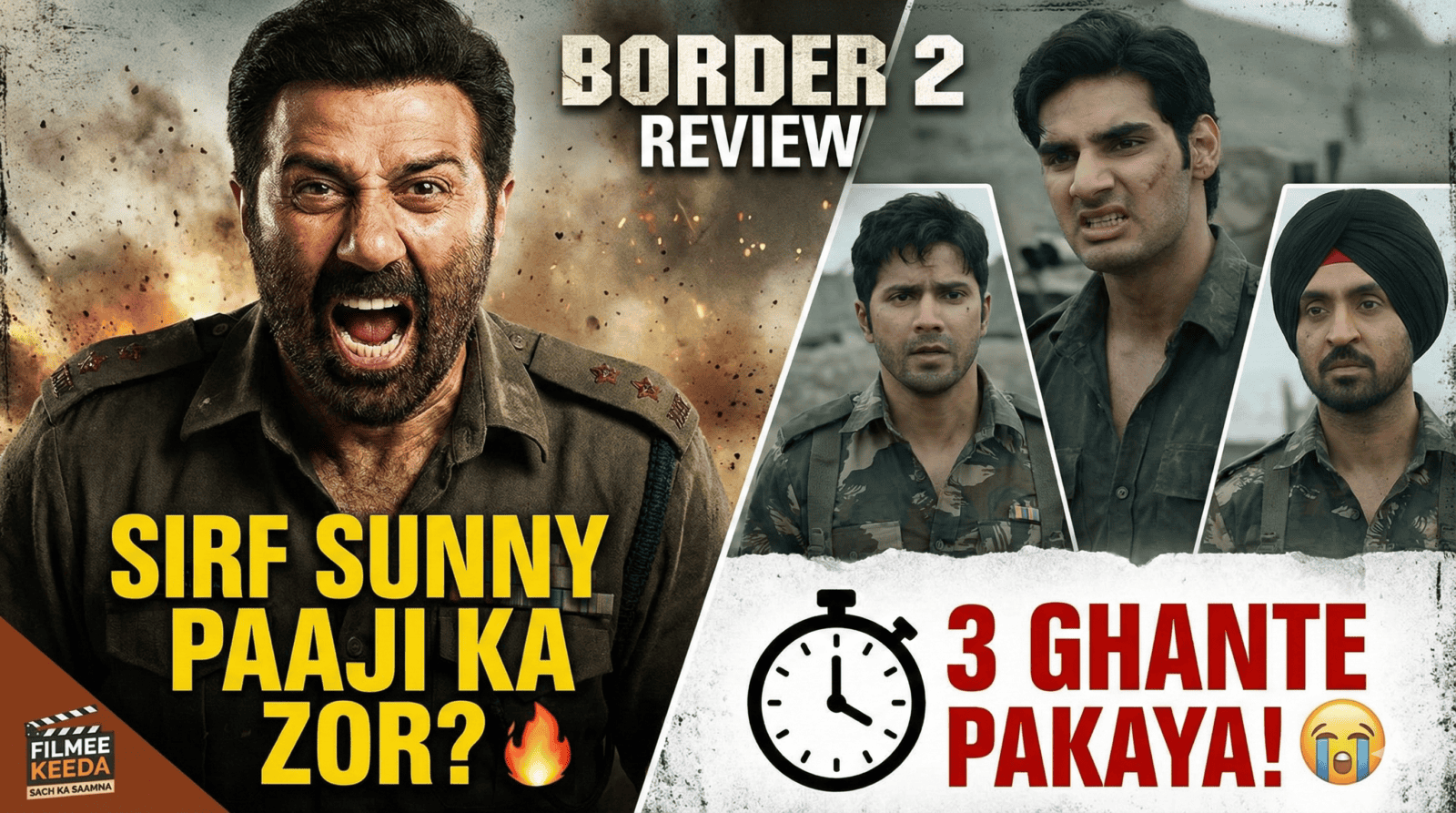
Border 2 Review
Border 2 comes with the weight of a legacy and the instant recall of Border 1’s iconic patriotic high. This time, the battle premise is set against the 1971 Indo–Pak war backdrop—and the film expands the familiar template by adding the Navy into the mix. Sounds promising on paper… but in execution, Border 2 often feels like it’s less interested in sharp cinema and more focused on squeezing emotion out of the audience for as long as possible.
If you’re going in for high-octane action, be ready: the film takes its sweet time getting there. But when it finally delivers, Sunny Deol reminds you exactly why you bought the ticket.
What’s Good ✅ (What Actually Works)
1. Sunny Deol’s presence hits instantly
- The moment he arrives, you feel it: that unmistakable “Sunny Paaji energy.”
- His line “Main kara doon border paar” lands with the exact theatre-level punch fans expect.
- His dialogue delivery + fight energy is the biggest payoff of the film.
2. The land mine sequence is a genuinely strong craft moment
- This sequence is powerfully staged and builds proper tension.
- It’s one of the rare moments where the film feels focused and cinematically intentional.
3. Climax fight delivers the adrenaline
- The climax action is genuinely good and gives you the rush the film keeps teasing.
- With stronger cinematography, this could’ve been a true standout.
4. Better picturized than Border 1
- Border 2 is a more polished-looking version of Border 1 in terms of presentation.
- The scale feels upgraded—even when the storytelling isn’t.
What’s Bad ❌
1. Story & screenplay feel stretched to “milk” patriotism
- It’s very obvious the film is dragging its runtime mainly to keep extracting patriotic emotion.
- The first half often feels like it has one job: “emotions nichodo jitna ho sake.”
- The result? You’re watching more emotional manipulation than organic drama.
2. Template-based storytelling gives heavy déjà vu
- The storyboard feels so familiar that it screams: Border 1 template + Navy added + bigger climax.
- If you’ve seen modern war films that follow the same beats, the pattern becomes even more noticeable.
3. The biggest issue: pacing (and a runtime that refuses to end)
- The film is so stretched it feels like the makers genuinely forgot to cut it down.
- It’s a 3+ hour film that could’ve been a tight, high-energy 1.5-hour war action ride if the narrative was sharper.
In-Depth Analysis 🎬 (Based on What the Film Repeatedly Shows You)
1) The film takes too long to reach what audiences came for
Border 2 has a clear audience promise: war spectacle, scale, and the kind of action that matches its patriotic intensity. But the structure doesn’t honor that promise early enough.
- After Sunny Deol’s impact moment, the film spends nearly 80 minutes where very little happens besides family drama—echoing the Border 1 approach.
- The problem isn’t just that the film is emotional—it’s that the emotion starts feeling like the only engine powering the first half.
In simple terms: the movie keeps telling you to feel things… before it gives you enough cinema to justify those feelings.
2) Varun Dhawan’s performance choices feel like a mismatch
Varun Dhawan’s entry happens, but it doesn’t feel “armyful.” More importantly, the dialogue styling doesn’t help him.
- His desi khadi boli feels forced and unnatural.
- The attempt to make him sound region-specific doesn’t land—he doesn’t come across as believable for the identity the film hints at.
This becomes a distraction because in a war film, you need authenticity in tone. Here, the performance texture feels more like a “character attempt” than a lived-in role.
3) The “Anpadh Lugai” scene feels inserted, not earned
One of the clearest examples of the film forcing relatability is the scene where Varun’s character shows up with his “anpadh lugai.”
- It does not change the story in any meaningful way.
- If you remove it, the narrative stays exactly the same.
- It plays more like a deliberate “tier-3 relatability” add-on than storytelling necessity.
When a film already struggles with pacing, sequences like this don’t just feel unnecessary—they actively make the runtime feel heavier.
4) The 90s-style romance/wedding vibe feels outdated in a war film like this
Border 2 leans into an older storytelling approach—where war narratives come packaged with romance and marriage beats.
- The issue is not the idea of human emotion in war.
- The issue is the execution: it feels like a default setting rather than a meaningful layer.
- The film could’ve benefited from skipping these familiar beats and replacing them with more unexpected, cinematic choices—something that serves both patriotism and cinema.
5) The cadet-style trio fights feel unintentionally funny
Varun, Ahan, and Diljit share moments that come off oddly childish—especially in “cadet days” sequences that have become a recurring Bollywood war-film pattern.
- Instead of intensity, the fighting sometimes feels awkward.
- At times it’s unintentionally comedic—because the vibe shifts away from war urgency into “template drama.”
This again reinforces the bigger complaint: Border 2 often feels like it’s repeating a format rather than building a fresh cinematic identity.
6) Entries and character moments: Diljit is underused, Ahan gets exaggerated hero moments
- Diljit’s entry is quite small, especially when he’s one of the more seasoned performers in the cast.
- Ahan Shetty’s entry includes a moment where placing Durga Maa’s picture instantly fixes a broken sonar.
- The symbolism is loud and the convenience is louder.
- It doesn’t feel earned; it feels like a shortcut to emotional impact.
This kind of writing contributes to the film’s tone: not subtle patriotism, but amplified patriotism—sometimes at the expense of credibility.
7) Logic gaps + Bollywood’s “One-Man Army” obsession return again
Border 2 repeatedly leans into the same heroic shortcut Bollywood loves:
- Ahan fires three torpedoes without calculating, and one still hits.
- The Air Force portion feels like it’s carried by one pilot fighting through the war.
- The Navy portion feels like it’s carried by one heroic officer who refuses to leave a sinking ship and saves comrades.
The question the film unintentionally raises is simple:
Why do war films keep shrinking massive operations into the myth of a single superhuman hero?
War cinema becomes more powerful when heroism feels collective and grounded. Here, it often feels like an action trope wearing a uniform.
8) Military protocol moments feel questionable
There’s also a behavioral realism issue in places:
- The junior–senior exchange where a junior insists “send me” even after orders have been decided—and the senior immediately agrees—feels off.
- If you’re watching with a detail-oriented lens, moments like this pull you out.
Even if you’re not an expert, the scene structure can feel dramatized in a way that doesn’t match the discipline the film is trying to celebrate.
Technical Notes 🎥
1. First hour (technically): neither excellent nor terrible—just expected.
2. VFX could’ve been better
- Especially when audiences are now used to much stronger visual polish.
3. Cinematography lacks a true “wow” factor
- The review lens here compares it to the kind of war-film cinematic impact seen in films like Greyhound (referenced as a benchmark for that “wow” feel).
- Border 2’s cinematography doesn’t consistently reach that level.
4. Pacing and runtime remain the biggest technical problems
- The film feels stretched beyond necessity.
Performances Ranking (As the Film Leaves You Feeling)
- Sunny Deol ✅ (clear #1)
- Diljit ✅ (solid, but underused)
- Varun Dhawan
- Ahan Shetty
Sunny and Diljit come across as seasoned. Varun and Ahan often feel like they’re still finding their footing in this genre.
Final Verdict ⭐ (Out of 5)
⭐ 2.5/5
Border 2 is a better picturized version of Border 1—but it’s also a film that loudly prioritizes patriotic noise over tight storytelling. It has strong moments (Sunny’s impact, the land mine sequence, and the climax fight), but it takes far too long to reach the action that should’ve arrived much earlier.
- 80% patriotism ka shor
- 20% cinematic value
Watch it if: you’re going for Sunny Deol and you can tolerate a long runtime for a few standout sequences.
Skip it if: you want a sharper, tighter war film that values cinema as much as it values emotion.
If you’ve watched Border 2, tell us: Did the land mine sequence work for you too? And did you also feel that “template wali” familiarity throughout the film?
