

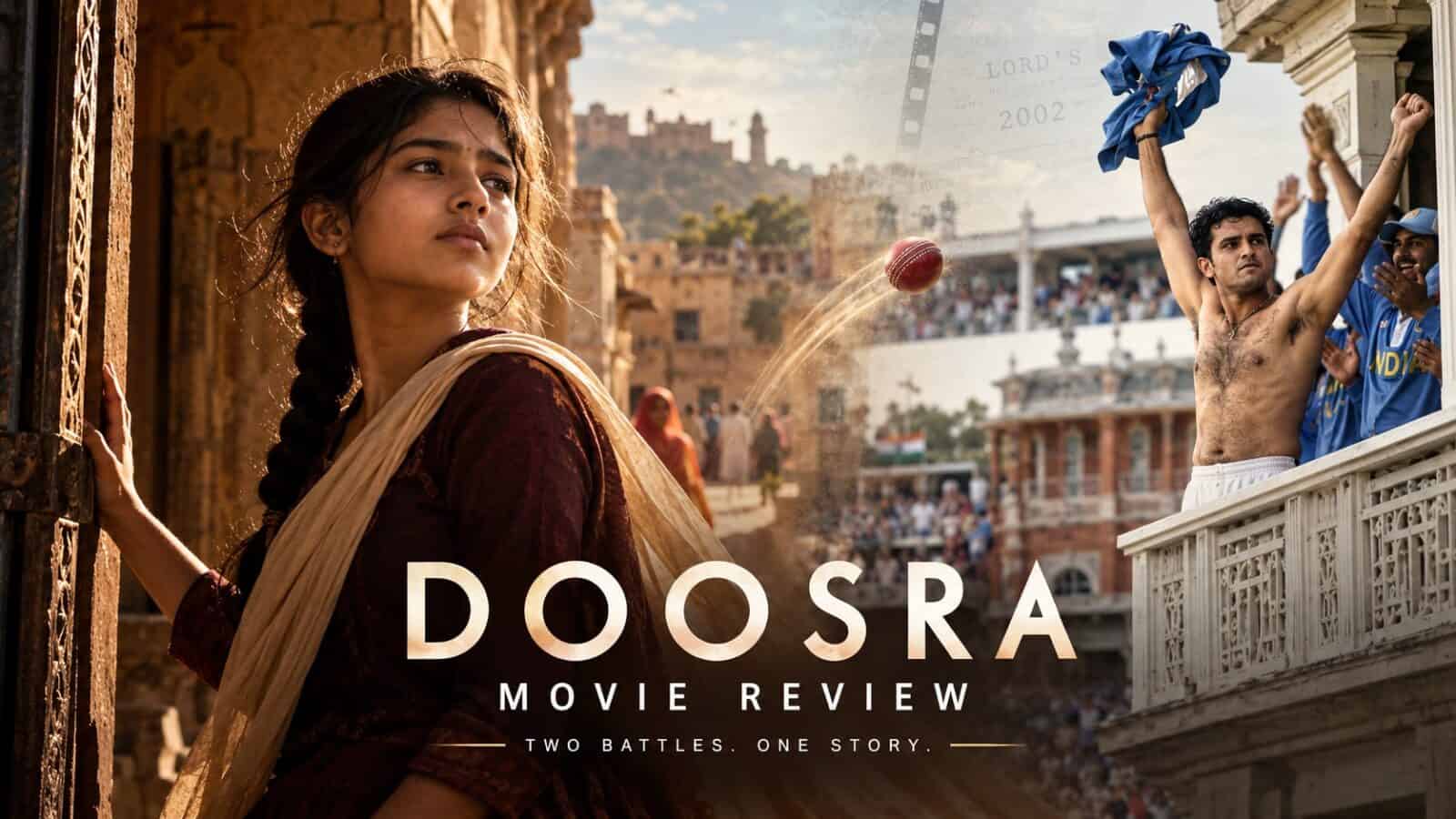
Doosra Movie Review
Remember Sourav Ganguly taking off his shirt at Lord’s? Of course you do! It is one of those iconic moments in Indian cricket history that almost every cricket fan remembers.
But how many of you know Tara’s story?
Probably none.
And that’s exactly what director Abhinay Deo’s Doosra tries to change.
The film takes two completely different stories—one involving Sourav Ganguly’s journey as Indian cricket captain and the other following a young girl growing up in a conservative Rajasthan town—and connects them through an ambitious metaphor.
The idea is brilliant. The performances are impressive. The direction is genuinely remarkable.
But despite getting so many things right, Doosra left me feeling that I had watched a promising story that never got enough room to fully develop.
Here’s why.
Doosra Movie Story: Two Different Battles, One Powerful Connection
Set between 1997 and 2002, Doosra introduces us to Tara, a young girl living in a small town in Rajasthan.
This was a time when girls were often treated as paraya dhan, expected to follow family expectations rather than question them or make their own choices.
Tara, however, has questions.
She questions her family, the restrictions around her and the expectations placed on her simply because she is a girl.
Meanwhile, the film follows Sourav Ganguly’s captaincy journey, exploring the challenges he faced while leading the Indian cricket team.
Now, you might be wondering: What does Ganguly’s cricketing journey have to do with a young girl’s life in Rajasthan?
That’s the central idea behind Doosra.
Rather than connecting both stories through a conventional plot, the film uses Ganguly’s struggles and Tara’s personal battles as a metaphor for challenging expectations and finding one’s identity.
And for the most part, that approach works surprisingly well.
What Is Doosra Really About?
On the surface, Doosra appears to be a film about cricket and the social environment of India in the late 1990s and early 2000s.
But there’s something much more personal underneath.
The film is essentially about two battles.
One is Sourav Ganguly’s struggle as captain, navigating challenges and expectations.
The other is Tara’s struggle to understand herself while growing up in an environment where questioning social norms isn’t easy.
As Tara grows older, the film also touches on her sexuality, the confusion surrounding it and what it meant to have a sexuality that was considered different in late-1990s and early-2000s India.
For me, this is where the film becomes particularly interesting.
Tara’s journey isn’t just about challenging her family. It’s about understanding her own identity in a society where even discussing these subjects could be difficult.
The metaphor connecting her life with Ganguly’s journey is thoughtful.
But I also feel this is the part of the story that deserved much more exploration.
Direction and Screenplay: Abhinay Deo Almost Gets It Perfect
I’ve always considered Abhinay Deo a very talented director, and Doosra gives me another reason to appreciate his filmmaking abilities.
The way he brings two completely different worlds together is impressive.
The film also features archival material featuring real-life sports personalities, journalists and philosophers.
And honestly, these segments are placed extremely well throughout the narrative.
They don’t feel like random additions. They help establish the film’s larger ideas and the environment in which both stories unfold.
Another thing that deserves appreciation is the authenticity of the period setting.
From the casting to the overall atmosphere, everything feels so believable that you might genuinely forget you’re watching it in 2026.
In terms of acting and direction, I would give Doosra a solid 10/10.
However, a strong concept and excellent execution in individual scenes don’t automatically make a completely satisfying film.
And that’s where Doosra struggles.
The screenplay seems more interested in explaining its metaphor than giving Tara’s personal journey the time it needs.
By the time the film reaches its conclusion, I was left wanting to understand much more about her life.
Performances: The Casting Makes the World Feel Real
One of the biggest strengths of Doosra is its casting, particularly the female performers.
There is something genuinely believable about the people and the environment the film presents.
The characters feel like they belong to that particular period rather than being modern characters placed inside a historical setting.
That authenticity makes Tara’s experiences more convincing.
The performances also carry the emotional weight of the film without making everything feel exaggerated.
I was particularly impressed by how naturally the actors fit into the world Abhinay Deo creates.
For a film built around personal struggles, social expectations and identity, that kind of believable acting makes a major difference.
What Works in Doosra?
1. The Realistic 1997–2002 Setting
This is easily among my favourite aspects of the film.
The casting, social environment and overall presentation make the period feel authentic.
You don’t just understand the timeline; you genuinely feel transported into it.
2. The Connection Between Cricket and Personal Freedom
Using Sourav Ganguly’s captaincy challenges as a metaphor for Tara’s personal struggles is a genuinely interesting creative decision.
These two stories couldn’t be more different on paper, yet the film manages to establish a meaningful thematic connection.
3. Brilliantly Placed Archival Footage
The real-life video clips featuring sports personalities, journalists and philosophers add a distinctive quality to the storytelling.
I particularly liked how these segments were woven into the narrative.
4. Strong Performances and Direction
The acting feels natural, the casting is convincing and Abhinay Deo demonstrates impressive control over the film’s atmosphere.
The action and emotional moments are also handled effectively.
There’s no denying the craftsmanship behind the film.
What Doesn’t Work in Doosra?
Despite all the positives, I have two major complaints.
1. The Film Sometimes Feels More Like a Documentary
Doosra is only 1 hour and 18 minutes long, so calling it lengthy would make absolutely no sense.
Yet there are moments when the film starts feeling more like a documentary than a conventional feature film.
The frequent use of archival footage, despite being thoughtfully placed, occasionally interrupts the emotional connection with Tara’s story.
And I can easily imagine some viewers losing interest during these portions.
In my estimation, nearly 35 minutes of the 78-minute runtime are devoted to archival material from Ganguly’s era.
That’s a significant amount of time for a film that is also trying to tell a deeply personal story.
In fact, I wouldn’t be surprised if some viewers initially mistake Doosra for a Sourav Ganguly biopic.
The archival footage is one of the film’s biggest strengths, but its extensive use also becomes one of its weaknesses.
2. Tara’s Story Deserved Much More Screen Time
This is my biggest disappointment with Doosra.
The film introduces a genuinely interesting character and raises important questions about sexuality, identity and social restrictions.
But just when you want to understand Tara more deeply, the story seems to run out of time.
I wanted the film to explore her experiences before and after she begins understanding her sexuality.
How does that understanding affect her life? What does it mean for someone growing up in that particular environment?
These are the questions I wanted the film to spend more time exploring.
Instead, the ending remains metaphorical, much like the rest of the film.
It relies on the audience to understand what the filmmaker is trying to communicate without explicitly explaining everything.
Now, I don’t have a problem with metaphorical endings.
But in this particular case, I felt the film needed more emotional development before reaching that point.
And that’s why the climax didn’t satisfy me as much as I had hoped.
Technical Aspects: Editing, Casting and Period Recreation
Technically, Doosra is extremely well put together.
The editing is impressive, particularly in the way the film combines Tara’s fictional journey with real-life cricket footage and commentary.
The period recreation is another major highlight.
The casting, atmosphere and attention to the social environment create a believable portrayal of the late 1990s and early 2000s.
The emotional moments also work because the performances remain grounded.
My issue isn’t with the quality of the editing or filmmaking.
It’s with how much narrative space is given to the two stories.
Reducing some of the Ganguly archival footage and spending that time on Tara’s personal journey could have made the overall experience much more rewarding.
Doosra Movie Review Verdict: A Missed Opportunity Despite Excellent Filmmaking
Here’s what makes Doosra frustrating.
I genuinely admire its concept, performances, direction and the way it presents its metaphor.
There are moments when the film feels like it could become something truly special.
But ultimately, I believe this story deserved 120 minutes, not 78.
An additional 40 minutes or so could have allowed the film to explore Tara’s journey more meaningfully without sacrificing its cricketing metaphor.
I can’t say whether budget constraints, creative decisions or some other reason resulted in the shorter runtime.
But watching the finished film, I couldn’t escape the feeling that a much bigger story had been compressed into a creative experiment.
Abhinay Deo is undoubtedly an excellent director, but for me, he falls one step short here.
Doosra starts with a brilliant idea and has almost everything needed to deliver a memorable experience.
Unfortunately, it never quite reaches the emotional depth that its subject deserves.
Should you watch Doosra?
Yes, especially if you appreciate unconventional storytelling, cricket history and films that explore social issues through symbolism.
But if you expect a fully developed character journey or a conventional, emotionally satisfying climax, the film may leave you wanting more.
My Rating: 2.5 stars
Final thought: Doosra isn’t disappointing because its idea fails. It’s disappointing because its idea deserved a bigger film.
Frequently Asked Questions About Doosra
1. What is the story of Doosra movie?
Doosra follows Tara, a young girl growing up in a small town in Rajasthan between 1997 and 2002. Her personal struggles are presented alongside Sourav Ganguly’s challenges as Indian cricket captain, connecting the two stories through a metaphor about identity and challenging expectations.
2. Is Doosra a Sourav Ganguly biopic?
No. Although Doosra includes extensive archival footage from Sourav Ganguly’s cricketing journey, the film also tells Tara’s story. It uses both narratives to explore broader themes rather than focusing exclusively on Ganguly’s life.
3. Who directed Doosra?
Doosra is directed by Abhinay Deo. His direction, period recreation and ability to connect two contrasting narratives are among the film’s strongest qualities.
4. What is the runtime of Doosra?
Doosra has a runtime of approximately 78 minutes (1 hour and 18 minutes). Despite its short duration, the film occasionally feels documentary-like because of its extensive archival footage.
5. Is Doosra worth watching?
Doosra is worth considering for its strong performances, realistic period setting and unusual storytelling concept. However, its documentary-like portions, limited exploration of Tara’s personal journey and metaphorical climax may not appeal to everyone. FilmeeKeeda rates it 2.5 stars.
